A shift from CPUs to LLMs: A New Age of Computing
How a CPU Works: The Brain of Your Computer
At its core, a CPU is a master of data manipulation—moving bits and bytes, performing arithmetic, and precisely accessing memory locations. It follows an explicit set of instructions, each a direct command specifying an exact operation. Individually, these operations seem simple, yet together they enable everything from sending emails to rendering sophisticated graphics in video games.
But how exactly does a CPU work? Unlike the fluid and nuanced processing of the human brain, a CPU operates strictly on binary instructions—sequences of 1s and 0s—guiding it on how to move data, perform calculations, and make logical decisions.
At a fundamental level, a CPU performs:
- Arithmetic operations: Addition, subtraction, multiplication, and division.
- Logical operations: Comparisons or bitwise manipulations such as AND, OR, and NOT.
- Data movement: Loading data into registers, storing data in memory, or transferring data between locations.
- Control flow operations: Deciding which instruction to execute next based on certain conditions.
These operations form a repeating sequence known as the fetch-decode-execute cycle:
- Fetch: Retrieve the next instruction from memory.
- Decode: Determine the specific operation to perform.
- Execute: Perform the instructed operation.
This cycle repeats billions of times per second, enabling complex computations and tasks—from basic arithmetic to running entire operating systems.
The LLM Analogy: Processing Language Instead of Bytes
Now, imagine if a CPU didn’t merely follow predefined instructions, but could interpret high-level requests, understand context, and even generate entirely new content. This is precisely what Large Language Models (LLMs) do—acting like CPUs, but processing human language instead of binary instructions.
Like CPUs, LLMs follow their own version of a fetch-decode-execute cycle:
- Fetch: The model receives your textual prompt and retrieves relevant context from vast amounts of training data.
- Decode: It analyzes the prompt, identifying patterns, meanings, and intentions embedded in the language.
- Execute: It generates a coherent and contextually relevant response—whether that’s answering a question, summarizing content, translating languages, or crafting creative writing.
Unlike CPUs that require precise and explicit instructions, LLMs can handle ambiguity, inference, and subtle contexts, making their interactions feel almost human.
For example:
- A CPU instructed to “add 2 and 2” performs exactly that operation.
- An LLM prompted to “Explain how a CPU works” evaluates the broad context and provides an insightful, detailed explanation tailored precisely to your request.
This ability to interpret and expand upon simple textual prompts showcases the profound capabilities of LLMs.
Program Development in CPUs vs. LLMs
In the early days of computing, software was rudimentary, constrained to simple tasks due to the limited complexity computers could manage. Over time, programming evolved significantly—from basic assembly languages offering slight abstraction from raw machine code, to high-level languages like FORTRAN and C, dramatically simplifying software development. Today, sophisticated libraries and frameworks abstract immense complexity, enabling the creation of advanced applications like video games and operating systems.
Parallel to this, LLMs have undergone their own transformation. Initially limited, early models produced fragmented and simplistic responses. However, breakthroughs like transformer architectures, massive datasets, vector embeddings, and techniques such as Retrieval-Augmented Generation (RAG) significantly enhanced their contextual understanding and output quality. Recent advances, such as incorporating explicit reasoning (exemplified by models like DeepSeek), have further refined LLM outputs into highly sophisticated, nuanced responses.
Yet, despite these parallel trajectories, CPUs and LLMs diverge significantly in how they handle complexity:
- CPUs require increasingly detailed, precise inputs (instructions) to perform complex tasks. The sophistication of the task depends directly on the complexity of the provided instructions.
- LLMs invert this relationship: their inputs—simple textual prompts—remain relatively uncomplicated, yet their outputs become increasingly sophisticated, reflecting the model’s internal capabilities rather than explicit complexity in the input.
This fundamental shift signifies a profound change in human-computer interaction. Traditional computing requires precise instructions—like a detailed recipe provided step-by-step. LLMs, however, encourage you to simply state your intent—like asking someone to cook dinner—allowing the model itself to navigate complexity.
Reimagining the Future: Enter the LLM OS
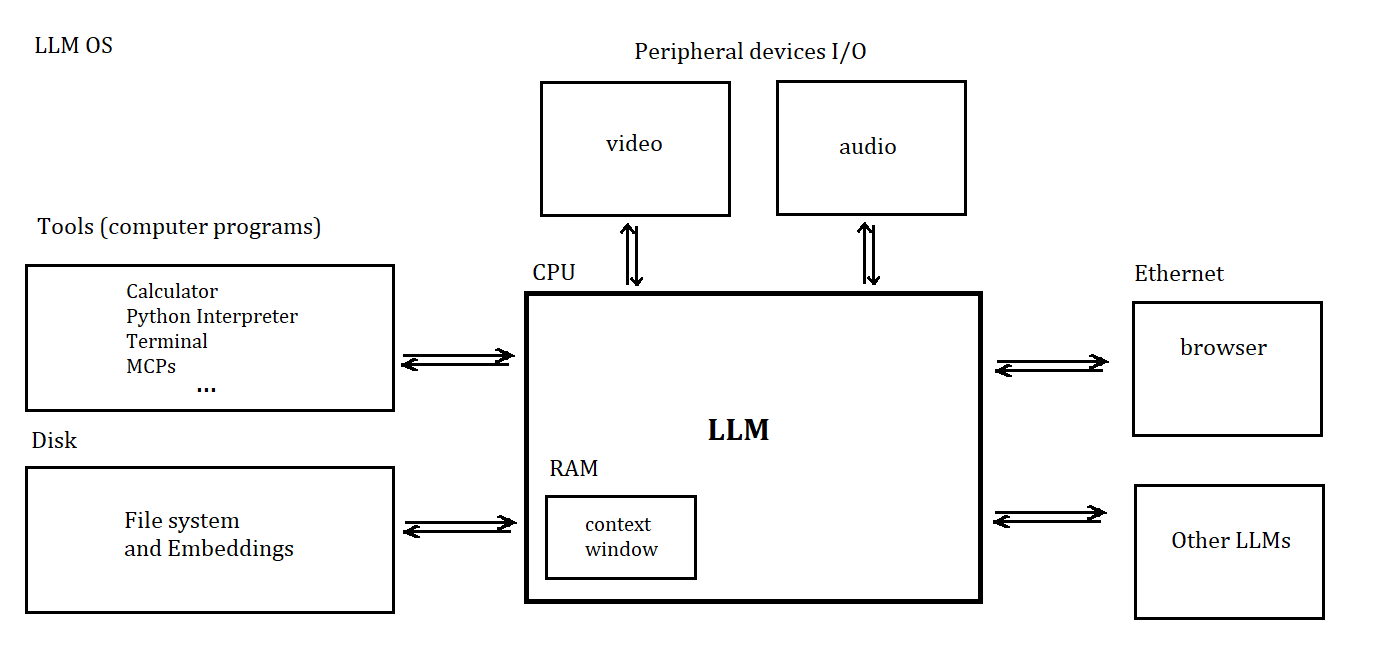
As we stand on the brink of a transformative technological era, the concept of an LLM-powered operating system—a groundbreaking idea popularized by thought leaders like Andrej Karpathy—offers a glimpse into a potential future. This vision redefines computing by placing natural language processing at its core.
In traditional operating systems, CPUs act as the central processors, crunching binary code and manipulating bytes, with RAM providing short-term memory. Conversely, an LLM OS replaces the CPU with an advanced language model that processes natural language instructions. Tokens—units of linguistic meaning—replace raw bytes, and the context window (short-term memory) acts like RAM, temporarily storing and processing relevant information.
This approach could revolutionize how we interact with technology—shifting from navigating menus or writing code to simply conversing naturally. Such a future promises to democratize computing further, empowering everyone to harness technology’s full potential without specialized knowledge.
Although still conceptual, the LLM OS hints at a profound shift in technology, one that redefines our relationship with machines through the natural and intuitive language we use daily. The dialogue between humans and machines has only just begun, poised to transform how we live, work, and create.
Why Invest Early in an LLM OS? The Business Payoff
In traditional computing, scaling a system often means adding more hardware—like servers—or optimizing software to handle bigger workloads. It’s resource-intensive and time-consuming. With an LLM OS, scaling takes on a new meaning: the system leverages the LLM’s ability to tackle increasingly complex tasks using simple language inputs. Instead of rewriting code or upgrading infrastructure, you “outsource” the scaling to the LLM’s growing intelligence. As the model improves, so does your system’s capability—without the heavy lifting.
For a company willing to adopt an LLM OS now, the rewards are both immediate and long-term. Here’s what they stand to gain:
Cost Efficiency
Building custom software for every new task or feature is expensive and slow. With an LLM OS, you can adapt to new challenges using natural language prompts—no need for a team of developers to code every solution from scratch. This slashes development costs and makes innovation more affordable.
Faster Time-to-Market
Speed is a competitive advantage. An LLM OS lets you roll out new products, features, or services in record time. What might have taken months of coding can now be accomplished in days—or even hours—by instructing the system in plain language.
Better Customer Experience
Imagine a customer service tool powered by an LLM OS: it answers questions, processes requests, and offers personalized recommendations—all with a human-like touch. As the LLM gets smarter, the tool improves on its own, delighting customers and boosting loyalty without extra effort.
Effortless Scalability
As the underlying LLM evolves, your system scales with it. No need to overhaul your infrastructure or rewrite software—your capabilities grow seamlessly as the technology advances.
First-Mover Advantage
Early adopters can pioneer new applications, from AI-driven analytics to automated content creation, opening up fresh revenue streams and setting themselves apart from competitors.
A Real-World Example
Picture a mid-sized e-commerce company facing a flood of customer inquiries during the holiday rush. Normally, they’d hire seasonal staff or invest in a rigid chatbot that needs constant tweaking. With an LLM OS, they deploy a language-driven assistant that handles:
- Product questions
- Returns and exchanges
- Personalized shopping suggestions
- Basic troubleshooting
Setup is minimal—just tell the system what to do. As the LLM learns, the assistant gets better, managing more complex interactions without updates or retraining. The company saves on operational costs, keeps customers happy, and gains an edge over rivals still stuck in the old way of doing things.
The Bottom Line
An LLM OS isn’t just a cool idea—it’s a game-changer for businesses. By investing early, companies can harness outsourced scaling to cut costs, move faster, delight customers, and scale effortlessly, all while positioning themselves as leaders in a new era of computing. The future of technology isn’t about building more machines—it’s about speaking to them. Those who master that conversation today will own tomorrow.